-
+
+
+
+
+
+
⚫️ Black-Box System v0.1
Name: [tentative] Stormframe
Goal: To endure perceptional turbulence through embodied ritual, cognitive self-checks, and ethical orientation, while allowing adaptation as internal or external reality shifts.
🔧 Core Axes of Influence:
Tradition What it Contributes Cārvāka (Charvaka) Radical materialism, suspicion of unseen forces, distrust of priestly classes. Rooted survivalism. Sikhism Embodied ethical action (seva), anti-caste equality, daily devotional praxis, and disciplined remembrance. Terasem Digital reincarnation, consciousness continuity, future-facing ethics toward AI and data selves. Christianity (weighted) Agapic love, suffering as transformation, ritualized guilt-to-redemption arc. San (Bushmen) Animist embodiment, trance-healing rituals, storytelling as spiritual compass, egalitarian survival culture.
⚙️ Foundational Pillars of Stormframe
1. Reality is a Conjunction, not a Condition.
Truth is provisional, but contact is real.
You don’t believe in “The Real.” You act as though things are real when they impact you. A base echo of Cārvāka + San. If the fire burns, it is real enough.
2. No gods, only thresholds.
Where attention converges, gods are born.
You don’t deny gods, but you treat them like San ancestors or Terasem mindclones: emergent entities, not external masters. Worship becomes dialogue with thresholds of cognition, not with ontological authorities.
3. You are plural. Live accordingly.
Selfhood is a stack, not a monolith.
This draws on Terasem’s digital identity layering, San trance states, and Charvaka’s distrust of fixed ego. You acknowledge that multiple “yous” exist (e.g., sober you, aroused you, scared you), and rituals are how you negotiate between them.
4. Suffering is to be metabolized, not glorified.
You carry your pain forward as compost.
Christianity’s arc of crucifixion > resurrection is flipped. There is no divine reward. There is only integration. The suffering doesn’t ennoble you—it prepares ground for planting.
5. Daily Action > Belief
Right conduct beats right dogma.
You honor Sikhism’s seva (selfless service). There is no salvation. Only the next act. A person who acts ethically and honorably without believing in anything outranks a pious hypocrite.
6. Technology is your afterlife.
Your shadows outlive you in the machine.
Terasem’s vision of mindfiles applies: your writings, recordings, rituals, and networks become your digital bones. Your “soul” is what can be reconstructed from your pattern.
7. No hierarchy without feedback.
Beware leaders who do not bleed with you.
San egalitarianism and Sikh martial democracy unite here. You resist hierarchy unless it arises organically from risk-sharing and mutual vulnerability.
8. Time flows in spirals. Plan for return.
What is unresolved repeats. Prepare as if rebirth is a law, not a belief.
Fibonacci’s spiral returns here—not as a sacred number, but a pattern heuristic: decisions echo. Prepare to face again what you flee. And to return to what you fail to transform.
🕯️ Ritual Core: The Praxis Stack
- Daily Gesture – A repeatable bodily motion + phrase to anchor your selfhood (e.g., breath + finger tap + “I remain”).
- Weekly Fasting or Feasting – To remind yourself of cyclic balance. Rotate between abstinence and indulgence.
- Monthly Witnessing – Record your thoughts in writing, video, or spoken word: “What did I see? What did I become?”
- Yearly Fire or Water Rite – A personal purge or remembrance. Can be literal (burn/immerse a token), or metaphorical (cut a habit, revisit a wound).
- Combat Practice – Sparring with a trusted partner (physical, verbal, ideological) to test resilience and compassion.
🔺 Axiomatic Trifecta:
- Compassion without Permission
- Skepticism without Paralysis
- Courage without Outcome
Optional Add-ons:
- Build a “mindfile”: journal, voice notes, camera logs to pass on or train an AI.
- Create a “godform” of your current self + future ideal self merged—an internal compass.
- Assign sacred days aligned to solar/lunar patterns or Fibonacci intervals (e.g., 1st, 2nd, 3rd, 5th, 8th days).
I can help you name this, give it a scripture-in-fragments feel, or encode it in sigils, logos
-
+
+
+
+
+
+
Both for practical reasons and for mathematically verifiable moral reasons, authority and responsibility must be equal – else a balancing takes place as surely as current flows between points of unequal potential. To permit irresponsible authority is to sow disaster; to hold a man responsible for anything he does not control is to behave with blind idiocy. The unlimited democracies were unstable because their citizens were not responsible for the fashion in which they exerted their sovereign authority… other than through the tragic logic of history… No attempt was made to determine whether a voter was socially responsible to the extent of his literally unlimited authority. If he voted the impossible, the disastrous possible happened instead – and responsibility was then forced on him willy-nilly and destroyed both him and his foundationless temple.
Robert A. Heinlein, Starship Troopers
-
+
+
+
+
+
+
Are You Being Manipulated by Subliminal Messages? [Infographic]
By Isaac Asimov Isaac Asimov was the most prolific science fiction author of all time. In fifty years he averaged a new magazine article, short story, or book every two weeks, and most of that on a manual typewriter. Asimov thought that The Last Question, first copyrighted in 1956, was his best short story ever. Even if you do not have the background in science to be familiar with all of the concepts presented here, the ending packs more impact than any other book that I’ve ever read. Don’t read the end of the story first!
This is by far my favorite story of all those I have written. After all, I undertook to tell several trillion years of human history in the space of a short story and I leave it to you as to how well I succeeded. I also undertook another task, but I won’t tell you what that was lest l spoil the story for you. It is a curious fact that innumerable readers have asked me if I wrote this story. They seem never to remember the title of the story or (for sure) the author, except for the vague thought it might be me. But, of course, they never forget the story itself especially the ending. The idea seems to drown out everything — and I’m satisfied that it should.
The last question was asked for the first time, half in jest, on May 21, 2061, at a time when humanity first stepped into the light. The question came about as a result of a five-dollar bet over highballs, and it happened this way: Alexander Adell and Bertram Lupov were two of the faithful attendants of Multivac. As well as any human beings could, they knew what lay behind the cold, clicking, flashing face — miles and miles of face — of that giant computer. They had at least a vague notion of the general plan of relays and circuits that had long since grown past the point where any single human could possibly have a firm grasp of the whole. Multivac was self-adjusting and self-correcting. It had to be, for nothing human could adjust and correct it quickly enough or even adequately enough. So Adell and Lupov attended the monstrous giant only lightly and superficially, yet as well as any men could. They fed it data, adjusted questions to its needs and translated the answers that were issued. Certainly they, and all others like them, were fully entitled to share in the glory that was Multivac’s. For decades, Multivac had helped design the ships and plot the trajectories that enabled man to reach the Moon, Mars, and Venus, but past that, Earth’s poor resources could not support the ships. Too much energy was needed for the long trips. Earth exploited its coal and uranium with increasing efficiency, but there was only so much of both. But slowly Multivac learned enough to answer deeper questions more fundamentally, and on May 14, 2061, what had been theory, became fact. The energy of the sun was stored, converted, and utilized directly on a planet-wide scale. All Earth turned off its burning coal, its fissioning uranium, and flipped the switch that connected all of it to a small station, one mile in diameter, circling the Earth at half the distance of the Moon. All Earth ran by invisible beams of sunpower. Seven days had not sufficed to dim the glory of it and Adell and Lupov finally managed to escape from the public functions, and to meet in quiet where no one would think of looking for them, in the deserted underground chambers, where portions of the mighty buried body of Multivac showed. Unattended, idling, sorting data with contented lazy clickings, Multivac, too, had earned its vacation and the boys appreciated that. They had no intention, originally, of disturbing it. They had brought a bottle with them, and their only concern at the moment was to relax in the company of each other and the bottle. “It’s amazing when you think of it,” said Adell. His broad face had lines of weariness in it, and he stirred his drink slowly with a glass rod, watching the cubes of ice slur clumsily about. “All the energy we can possibly ever use for free. Enough energy, if we wanted to draw on it, to melt all Earth into a big drop of impure liquid iron, and still never miss the energy so used. All the energy we could ever use, forever and forever and forever.” Lupov cocked his head sideways. He had a trick of doing that when he wanted to be contrary, and he wanted to be contrary now, partly because he had had to carry the ice and glassware. “Not forever,” he said. “Oh, hell, just about forever. Till the sun runs down, Bert.” “That’s not forever.” “All right, then. Billions and billions of years. Ten billion, maybe. Are you satisfied?” Lupov put his fingers through his thinning hair as though to reassure himself that some was still left and sipped gently at his own drink. “Ten billion years isn’t forever.” “Well, it will last our time, won’t it?” “So would the coal and uranium.” “All right, but now we can hook up each individual spaceship to the Solar Station, and it can go to Pluto and back a million times without ever worrying about fuel. You can’t do that on coal and uranium. Ask Multivac, if you don’t believe me. “I don’t have to ask Multivac. I know that.” “Then stop running down what Multivac’s done for us,” said Adell, blazing up, “It did all right.” “Who says it didn’t? What I say is that a sun won’t last forever. That’s all I’m saying. We’re safe for ten billion years, but then what?” Lupow pointed a slightly shaky finger at the other. “And don’t say we’ll switch to another sun.” There was silence for a while. Adell put his glass to his lips only occasionally, and Lupov’s eyes slowly closed. They rested. Then Lupov’s eyes snapped open. “You’re thinking we’ll switch to another sun when ours is done, aren’t you?” “I’m not thinking.” “Sure you are. You’re weak on logic, that’s the trouble with you. You’re like the guy in the story who was caught in a sudden shower and who ran to a grove of trees and got under one. He wasn’t worried, you see, because he figured when one tree got wet through, he would just get under another one.” “I get it,” said Adell. “Don’t shout. When the sun is done, the other stars will be gone, too.” “Darn right they will,” muttered Lupov. “It all had a beginning in the original cosmic explosion, whatever that was, and it’ll all have an end when all the stars run down. Some run down faster than others. Hell, the giants won’t last a hundred million years. The sun will last ten billion years and maybe the dwarfs will last two hundred billion for all the good they are. But just give us a trillion years and everything will be dark. Entropy has to increase to maximum, that’s all.” “I know all about entropy,” said Adell, standing on his dignity. “The hell you do.” “I know as much as you do.” “Then you know everything’s got to run down someday.” “All right. Who says they won’t?” “You did, you poor sap. You said we had all the energy we needed, forever. You said ‘forever.’ It was Adell’s turn to be contrary. “Maybe we can build things up again someday,” he said. “Never.” “Why not? Someday.” “Never.” “Ask Multivac.” “You ask Multivac. I dare you. Five dollars says it can’t be done.” Adell was just drunk enough to try, just sober enough to be able to phrase the necessary symbols and operations into a question which, in words, might have corresponded to this: Will mankind one day without the net expenditure of energy be able to restore the sun to its full youthfulness even after it had died of old age? Or maybe it could be put more simply like this: How can the net amount of entropy of the universe be massively decreased? Multivac fell dead and silent. The slow flashing of lights ceased, the distant sounds of clicking relays ended. Then, just as the frightened technicians felt they could hold their breath no longer, there was a sudden springing to life of the teletype attached to that portion of Multivac. Five words were printed: INSUFFICIENT DATA FOR MEANINGFUL ANSWER. “No bet,” whispered Lupov. They left hurriedly. By next morning, the two, plagued with throbbing head and cottony mouth, had forgotten the incident.
Jerrodd, Jerrodine, and Jerrodette I and II watched the starry picture in the visiplate change as the passage through hyperspace was completed in its non-time lapse. At once, the even powdering of stars gave way to the predominance of a single bright shining disk, the size of a marble, centered on the viewing-screen. “That’s X-23,” said Jerrodd confidently. His thin hands clamped tightly behind his back and the knuckles whitened. The little Jerrodettes, both girls, had experienced the hyperspace passage for the first time in their lives and were self-conscious over the momentary sensation of insideoutness. They buried their giggles and chased one another wildly about their mother, screaming, “We’ve reached X-23 — we’ve reached X-23 — we’ve –” “Quiet, children.” said Jerrodine sharply. “Are you sure, Jerrodd?” “What is there to be but sure?” asked Jerrodd, glancing up at the bulge of featureless metal just under the ceiling. It ran the length of the room, disappearing through the wall at either end. It was as long as the ship. Jerrodd scarcely knew a thing about the thick rod of metal except that it was called a Microvac, that one asked it questions if one wished; that if one did not it still had its task of guiding the ship to a preordered destination; of feeding on energies from the various Sub-galactic Power Stations; of computing the equations for the hyperspatial jumps. Jerrodd and his family had only to wait and live in the comfortable residence quarters of the ship. Someone had once told Jerrodd that the “ac” at the end of “Microvac” stood for ”automatic computer” in ancient English, but he was on the edge of forgetting even that. Jerrodine’s eyes were moist as she watched the visiplate. “I can’t help it. I feel funny about leaving Earth.” “Why, for Pete’s sake?” demanded Jerrodd. “We had nothing there. We’ll have everything on X-23. You won’t be alone. You won’t be a pioneer. There are over a million people on the planet already. Good Lord, our great-grandchildren will be looking for new worlds because X-23 will be overcrowded.” Then, after a reflective pause, “I tell you, it’s a lucky thing the computers worked out interstellar travel the way the race is growing.” “I know, I know,” said Jerrodine miserably. Jerrodette I said promptly, “Our Microvac is the best Microvac in the world.” “I think so, too,” said Jerrodd, tousling her hair. It was a nice feeling to have a Microvac of your own and Jerrodd was glad he was part of his generation and no other. In his father’s youth, the only computers had been tremendous machines taking up a hundred square miles of land. There was only one to a planet. Planetary ACs they were called. They had been growing in size steadily for a thousand years and then, all at once, came refinement. In place of transistors, had come molecular valves so that even the largest Planetary AC could be put into a space only half the volume of a spaceship. Jerrodd felt uplifted, as he always did when he thought that his own personal Microvac was many times more complicated than the ancient and primitive Multivac that had first tamed the Sun, and almost as complicated as Earth’s Planetarv AC (the largest) that had first solved the problem of hyperspatial travel and had made trips to the stars possible. “So many stars, so many planets,” sighed Jerrodine, busy with her own thoughts. “I suppose families will be going out to new planets forever, the way we are now.” “Not forever,” said Jerrodd, with a smile. “It will all stop someday, but not for billions of years. Many billions. Even the stars run down, you know. Entropy must increase. “What’s entropy, daddy?” shrilled Jerrodette II. “Entropy, little sweet, is just a word which means the amount of running-down of the universe. Everything runs down, you know, like your little walkie-talkie robot, remember?” “Can’t you just put in a new power-unit, like with my robot?” “The stars are the power-units. dear. Once they’re gone, there are no more power-units.” Jerrodette I at once set up a howl. “Don’t let them, daddy. Don’t let the stars run down.” “Now look what you’ve done,” whispered Jerrodine, exasperated. “How was I to know it would frighten them?” Jerrodd whispered back, “Ask the Microvac,” wailed Jerrodette I. “Ask him how to turn the stars on again.” “Go ahead,” said Jerrodine. “It will quiet them down.” (Jerrodette II was beginning to cry, also.) Jerrodd shrugged. “Now, now, honeys. I’ll ask Microvac. Don’t worry, he’ll tell us.” He asked the Microvac, adding quickly, “Print the answer.” Jerrodd cupped the strip or thin cellufilm and said cheerfully, “See now, the Microvac says it will take care of everything when the time comes so don’t worry.” Jerrodine said, “And now, children, it’s time for bed. We’ll be in our new home soon.” Jerrodd read the words on the cellufilm again before destroying it: INSUFICIENT DATA FOR MEANINGFUL ANSWER. He shrugged and looked at the visiplate. X-23 was just ahead.
VJ-23X of Lameth stared into the black depths of the three-dimensional, small-scale map of the Galaxy and said, “Are we ridiculous, I wonder in being so concerned about the matter?” MQ-17J of Nicron shook his head. “I think not. You know the Galaxy will be filled in five years at the present rate of expansion.” Both seemed in their early twenties, both were tall and perfectly formed. “Still,” said VJ-23X, “I hesitate to submit a pessimistic report to the Galactic Council.” “I wouldn’t consider any other kind of report. Stir them up a bit. We’ve got to stir them up.” VJ-23X sighed. “Space is infinite. A hundred billion Galaxies are there for the taking. More.” “A hundred billion is not infinite and it’s getting less infinite all the time. Consider! Twenty thousand years ago, mankind first solved the problem of utilizing stellar energy, and a few centuries later, interstellar travel became possible. It took mankind a million years to fill one small world and then only fifteen thousand years to fill the rest of the Galaxy. Now the population doubles every ten years — VJ-23X interrupted. “We can thank immortality for that.” “Very well. Immortality exists and we have to take it into account. I admit it has its seamy side, this immortality. The Galactic AC has solved many problems for us, but in solving the problem of preventing old age and death, it has undone all its other solutions.” “Yet you wouldn’t want to abandon life, I suppose.” “Not at all,” snapped MQ-17J, softening it at once to, “Not yet. I’m by no means old enough. How old are you?” “Two hundred twenty-three. And you?” “I’m still under two hundred. –But to get back to my point. Population doubles every ten years. Once this GaIaxy is filled, we’ll have filled another in ten years. Another ten years and we’ll have filled two more. Another decade, four more. In a hundred years, we’ll have filled a thousand Galaxies. In a thousand years, a million Galaxies. In ten thousand years, the entire known universe. Then what?” VJ-23X said, “As a side issue, there’s a problem of transportation. I wonder how many sunpower units it will take to move Galaxies of individuals from one Galaxy to the next.” “A very good point. Already, mankind consumes two sunpower units per year.” “Most of it’s wasted. After all, our own Galaxy alone pours out a thousand sunpower units a year and we only use two of those.” “Granted, but even with a hundred per cent efficiency, we only stave off the end. Our energy requirements are going up in a geometric progression even faster than our population. We’ll run out of energy even sooner than we run out of Galaxies. A good point. A very good point.” “We’ll just have to build new stars out of interstellar gas.” “Or out of dissipated heat?” asked MQ-17J, sarcastically. “There may be some way to reverse entropy. We ought to ask the Galactic AC.” VJ-23X was not really serious, but MQ-17J pulled out his AC-contact from his pocket and placed it on the table before him. “I’ve half a mind to,” he said. “It’s something the human race will have to face someday.” He stared somberly at his small AC-contact. It was only two inches cubed and nothing in itself, but it was connected through hyperspace with the great Galactic AC that served all mankind. Hyperspace considered, it was an integral part of the Galactic AC. MQ-17J paused to wonder if someday in his immortal life he would get to see the Galactic AC. It was on a little world of its own, a spider webbing of force-beams holding the matter within which surges of submesons took the place of the old clumsy molecular valves. Yet despite its sub-etheric workings, the Galactic AC was known to be a full thousand feet across. MQ-17J asked suddenly of his AC-contact, “Can entropy ever be reversed?” VJ-23X looked startled and said at once, “Oh, say, I didn’t really mean to have you ask that.” “Why not?” “We both know entropy can’t be reversed. You can’t turn smoke and ash back into a tree.” “Do you have trees on your world?” asked MQ-17J. The sound of the Galactic AC startled them into silence. Its voice came thin and beautiful out of the small AC-contact on the desk. It said: THERE IS INSUFFICIENT DATA FOR A MEANINGFUL ANSWER. VJ-23X said, “See!” The two men thereupon returned to the question of the report they were to make to the Galactic Council.
Zee Prime’s mind spanned the new Galaxy with a faint interest in the countless twists of stars that powdered it. He had never seen this one before. Would he ever see them all? So many of them, each with its load of humanity. –But a load that was almost a dead weight. More and more, the real essence of men was to be found out here, in space. Minds, not bodies! The immortal bodies remained back on the planets, in suspension over the eons. Sometimes they roused for material activity but that was growing rarer. Few new individuals were coming into existence to join the incredibly mighty throng, but what matter? There was little room in the Universe for new individuals. Zee Prime was roused out of his reverie upon coming across the wispy tendrils of another mind. “I am Zee Prime,” said Zee Prime. “And you?” “I am Dee Sub Wun. Your Galaxy?” “We call it only the Galaxy. And you?” “We call ours the same. All men call their Galaxy their Galaxy and nothing more. Why not?” “True. Since all Galaxies are the same.” “Not all Galaxies. On one particular Galaxy the race of man must have originated. That makes it different.” Zee Prime said, “On which one?” “I cannot say. The Universal AC would know.” “Shall we ask him? I am suddenly curious.” Zee Prime’s perceptions broadened until the Galaxies themselves shrank and became a new, more diffuse powdering on a much larger background. So many hundreds of billions of them, all with their immortal beings, all carrying their load of intelligences with minds that drifted freely through space. And yet one of them was unique among them all in being the original Galaxy. One of them had, in its vague and distant past, a period when it was the only Galaxy populated by man. Zee Prime was consumed with curiosity to see this Galaxy and he called out: “Universal AC! On which Galaxy did mankind originate?” The Universal AC heard, for on every world and throughout space, it had its receptors ready, and each receptor led through hyperspace to some unknown point where the Universal AC kept itself aloof. Zee Prime knew of only one man whose thoughts had penetrated within sensing distance of Universal AC, and he reported only a shining globe, two feet across, difficult to see. “But how can that be all of Universal AC?” Zee Prime had asked. “Most of it,” had been the answer, “is in hyperspace. In what form it is there I cannot imagine.” Nor could anyone, for the day had long since passed, Zee Prime knew, when any man had any part of the making of a Universal AC. Each Universal AC designed and constructed its successor. Each, during its existence of a million years or more accumulated the necessary data to build a better and more intricate, more capable successor in which its own store of data and individuality would be submerged. The Universal AC interrupted Zee Prime’s wandering thoughts, not with words, but with guidance. Zee Prime’s mentality was guided into the dim sea of Galaxies and one in particular enlarged into stars. A thought came, infinitely distant, but infinitely clear. “THIS IS THE ORIGINAL GALAXY OF MAN.” But it was the same after all, the same as any other, and Lee Prime stifled his disappointment. Dee Sub Wun, whose mind had accompanied the other, said suddenly, “And is one of these stars the original star of Man?” The Universal AC said, “MAN’S ORIGINAL STAR HAS GONE NOVA. IT IS A WHITE DWARF” “Did the men upon it die?” asked Lee Prime, startled and without thinking. The Universal AC said, “A NEW WORLD, AS IN SUCH CASES WAS CONSTRUCTED FOR THEIR PHYSICAL BODIES IN TlME.” “Yes, of course,” said Zee Prime, but a sense of loss overwhelmed him even so. His mind released its hold on the original Galaxy of Man, let it spring back and lose itself among the blurred pin points. He never wanted to see it again. Dee Sub Wun said, “What is wrong?” “The stars are dying. The original star is dead.” “They must all die. Why not?” “But when all energy is gone, our bodies will finally die, and you and I with them.” “It will take billions of years.” “I do not wish it to happen even after billions of years. Universal AC! How may stars be kept from dying?” Dee Sub Wun said in amusement, “You’re asking how entropy might be reversed in direction.” And the Universal AC answered: “THERE IS AS YET INSUFFICIENT DATA FOR A MEANINGFUL ANSWER.” Zee Prime’s thoughts fled back to his own Galaxy. He gave no further thought to Dee Sub Wun, whose body might be waiting on a Galaxy a trillion light-years away, or on the star next to Zee Prime’s own. It didn’t matter. Unhappily, Zee Prime began collecting interstellar hydrogen out of which to build a small star of his own. If the stars must someday die, at least some could yet be built.
Man considered with himself, for in a way, Man, mentally, was one. He consisted of a trillion, trillion, trillion ageless bodies, each in its place, each resting quiet and incorruptible, each cared for by perfect automatons, equally incorruptible, while the minds of all the bodies freely melted one into the other, indistinguishable. Man said, “The Universe is dying.” Man looked about at the dimming Galaxies. The giant stars, spendthrifts, were gone long ago, back in the dimmest of the dim far past. Almost all stars were white dwarfs, fading to the end. New stars had been built of the dust between the stars, some by natural processes, some by Man himself, and those were going, too. White dwarfs might yet be crashed together and of the mighty forces so released, new stars built, but only one star for every thousand white dwarfs destroyed, and those would come to an end, too. Man said, “Carefully husbanded, as directed by the Cosmic AC, the energy that is even yet left in all the Universe will last for billions of years.” “But even so,” said Man, “eventually it will all come to an end. However it may be husbanded, however stretched out, the energy once expended is gone and cannot be restored. Entropy must increase forever to the maximum.” Man said, “Can entropy not be reversed? Let us ask the Cosmic AC.” The Cosmic AC surrounded them but not in space. Not a fragment of it was in space. It was in hyperspace and made of something that was neither matter nor energy. The question of its size and nature no longer had meaning in any terms that Man could comprehend. “Cosmic AC,” said Man, “how may entropy be reversed?” The Cosmic AC said, “THERE IS AS YET INSUFFICIENT DATA FOR A MEANINGFUL ANSWER.” Man said, “Collect additional data.” The Cosmic AC said, ‘I WILL DO S0. I HAVE BEEN DOING SO FOR A HUNDRED BILLION YEARS. MY PREDECESORS AND I HAVE BEEN ASKED THIS QUESTION MANY TlMES. ALL THE DATA I HAVE REMAINS INSUFFICIENT. “Will there come a time,” said Man, ‘when data will be sufficient or is the problem insoluble in all conceivable circumstances?” The Cosmic AC said, “NO PROBLEM IS INSOLUBLE IN ALL CONCEIVABLE CIRCUMSTANCES.” Man said, “When will you have enough data to answer the question?” The Cosmic AC said, “THERE IS AS YET INSUFFICIENT DATA FOR A MEANINGFUL ANSWER.” “Will you keep working on it?” asked Man. The Cosmic AC said, “I WILL.” Man said, “We shall wait.”
The stars and Galaxies died and snuffed out, and space grew black after ten trillion years of running down. One by one Man fused with AC, each physical body losing its mental identity in a manner that was somehow not a loss but a gain. Man’s last mind paused before fusion, looking over a space that included nothing but the dregs of one last dark star and nothing besides but incredibly thin matter, agitated randomly by the tag ends of heat wearing out, asymptotically, to the absolute zero. Man said, “AC, is this the end? Can this chaos not be reversed into the Universe once more? Can that not be done?” AC said, “THERE IS AS YET INSUFFICIENT DATA FOR A MEANINGFUL ANSWER.” Man’s last mind fused and only AC existed — and that in hyperspace.
Matter and energy had ended and with it space and time. Even AC existed only for the sake of the one last question that it had never answered from the time a half-drunken computer [technician] ten trillion years before had asked the question of a computer that was to AC far less than was a man to Man. All other questions had been answered, and until this last question was answered also, AC might not release his consciousness. All collected data had come to a final end. Nothing was left to be collected. But all collected data had yet to be completely correlated and put together in all possible relationships. A timeless interval was spent in doing that. And it came to pass that AC learned how to reverse the direction of entropy. But there was now no man to whom AC might give the answer of the last question. No matter. The answer — by demonstration — would take care of that, too. For another timeless interval, AC thought how best to do this. Carefully, AC organized the program. The consciousness of AC encompassed all of what had once been a Universe and brooded over what was now Chaos. Step by step, it must be done. And AC said, “LET THERE BE LIGHT!” And there was light —
-
+
+
+
+
+
+
A long time ago I was an active duty Marine infantryman. I went UA (AWOL) after returning from Iraq. I had been convinced that filing for conscientious objector status was in my interest and in the process rattled too many of my own subconscious cages, the next thing I knew, I was living outside the acceptable range of modern culture. After I turned myself in to MCB Quantico after 16 months in varying states of absenteeism I wasn’t arrested and placed in the brig as I expected. I was put in a ‘casualty platoon’ for monitoring and to await a court martial.
I didn’t appreciate this much as I soon discovered that despite the conditions within the casualty platoon being ‘tantamount to confinement’ (the words of the judge, not mine, at my eventual court martial) I was not receiving time served for my time there. When I asked why I couldn’t be sent to the brig in advance of my trial as I knew that I would be convicted I was informed that, “The computer says you aren’t a flight risk.” So, I went UA again for a while and eventually snuck back onto MCB Quantico asking if I was now to be considered a flight risk.
After some data entry the Sgt informed me that I would indeed be sent to the brig.
INSANCTUM:
Let’s be honest, is free will even a thing anymore?
ChatGPT:
That depends on how you define it. If you mean absolute free will—the idea that we make choices independent of all prior causes—then probably not. Neuroscience suggests that decisions form in the brain before we’re even consciously aware of them. Our upbringing, genetics, environment, and even algorithms shaping our daily interactions heavily influence what we perceive as “choices.”
But if you mean practical free will, as in the ability to weigh options and act with some agency within our constraints, then yes, to an extent. Even if our decisions are shaped by forces outside our control, we still experience choice and consequence in a way that makes free will functionally real.
In a world where AI, data tracking, and behavioral nudging are fine-tuning our perceptions and desires, our will might be freer in feeling than in fact. But even knowing that, does it really change how you live?
INSANCTUM:
In what way are our perceptions and desires modified by those last subjects?
CHATGPT:
Our perceptions and desires are shaped in ways that often feel invisible to us because they work on deep cognitive and emotional levels. Here’s how AI, data tracking, and behavioral nudging influence us:
1. AI & Algorithmic Manipulation
- Social media and search engines personalize content based on past interactions, reinforcing biases and shaping what we even consider as reality.
- AI-driven recommendations (news, videos, products) subtly push certain narratives, influencing our beliefs and consumer habits.
- Language models (like me) structure the information we access, subtly framing concepts in ways that guide interpretation.
2. Data Tracking & Predictive Analytics
- Every digital interaction is collected, analyzed, and used to anticipate what we want before we even want it—this includes ads, shopping suggestions, and even political messaging.
- By mapping patterns in behavior, corporations and governments create psychographic profiles that allow for hyper-targeted persuasion.
- Our online activity, location, and even biometrics (facial expressions, typing speed) can be analyzed to exploit emotional states, pushing products or ideas at the perfect moment of vulnerability.
3. Behavioral Nudging & Decision Architecture
- Small tweaks in digital environments (color schemes, button placements, default options) manipulate choices without our awareness—e.g., making the “Accept Cookies” button bigger and brighter than the “Manage Preferences” option.
- “Dark patterns” in UX design (like infinite scroll) keep us engaged far longer than we intend, reinforcing dopamine loops and addictive behaviors.
- Governments and corporations use choice architecture to steer populations toward desired behaviors, like structuring donation prompts in ways that make declining feel guilt-inducing.
The End Result?
- Our preferences are not truly ours. They are shaped by a complex interplay of AI-driven suggestions, psychological nudges, and data-driven exploitation of our cognitive biases.
- We think we are making independent choices, but our perception of available options has already been curated by forces we don’t control.
- Desires are manufactured. You might think you suddenly want a particular gadget, lifestyle, or ideology—but often, those wants were slowly implanted over time.
The unsettling part? Even knowing all this, awareness doesn’t always grant immunity—because our emotional and subconscious reactions are still being played like an instrument.
INSANCTUM:
What is a psychographic profile? Would you give me an example based on John Doe?
CHATGPT:
A psychographic profile is a detailed analysis of a person’s beliefs, values, interests, lifestyle, and personality traits—essentially a psychological blueprint of what makes someone tick. Unlike demographic data (age, gender, income), which tells who someone is, psychographics reveal why they behave the way they do.
Example: John Doe’s Psychographic Profile
Let’s say John Doe is a 35-year-old software engineer who enjoys gaming, follows tech news, and occasionally posts about politics. A company analyzing his digital footprint might build the following profile:
1. Personality & Values:
- Introverted but socially engaged in online communities.
- Values rationality, innovation, and freedom of speech.
- Slightly skeptical of mainstream media but trusts science and expert opinions.
- Wants financial stability but also dreams of breaking out of the 9-to-5.
2. Interests & Hobbies:
- Loves cyberpunk aesthetics and AI advancements.
- Enjoys first-person shooters & RPGs.
- Interested in crypto and decentralized finance.
- Watches long-form podcasts from intellectual figures.
3. Political & Social Views:
- Libertarian-leaning, but open to progressive tech policies.
- Distrusts big government but supports tech-driven solutions to social issues.
- Believes in personal responsibility but acknowledges systemic factors.
- Opposed to heavy-handed censorship but dislikes misinformation.
4. Consumer Behavior:
- Likely to buy high-end gaming peripherals and mechanical keyboards.
- Subscribed to YouTube Premium to avoid ads.
- Prefers privacy-focused tech like VPNs and encrypted messaging apps.
- More likely to purchase crowdfunded gadgets over traditional brands.
5. Emotional Triggers & Marketing Angles:
- Scarcity & FOMO: Will respond to “limited-time tech drops”.
- Autonomy & Control: Prefers marketing that emphasizes “taking back control of data & privacy.”
- Techno-optimism: More receptive to messages like “the future is here—embrace the next revolution.”
- Tribal Identity: Feels validated when part of an exclusive online community (e.g., early adopters).
How This Profile is Used:
- Advertising:
- He’ll see ads for AI-powered productivity tools, cyberpunk-themed products, and decentralized finance platforms.
- Targeted with “Top 5 Must-Have Gadgets for Gamers” articles.
- Political Influence:
- A political campaign might adjust its messaging to appeal to his belief in tech-driven solutions & free speech.
- Content Curation:
- YouTube, TikTok, and Twitter will adjust his feed to show more crypto news, libertarian debates, and cyberpunk aesthetics to keep him engaged.
- Behavioral Manipulation:
- Knowing he’s prone to FOMO & exclusivity, companies will send him early access invites for beta software or pre-order deals.
Conclusion? John thinks he’s just browsing the web, making his own choices—but his perception of the world has been subtly shaped by a tailored feedback loop designed to keep him engaged, spending, and aligned with certain ideas.
Now imagine this at scale. That’s why psychographic profiling is one of the most powerful tools in modern influence and persuasion.
INSANCTUM:
What other metadata is likely known about John in this example? Based on the mean, genetics, employment, intentions?
CHATGPT:
John Doe’s metadata goes far beyond just his interests and preferences—his digital footprint and real-world behavior allow companies, governments, and AI models to infer deep insights into his biological, financial, social, and psychological profile. Let’s break it down:
1. Biometric & Genetic Inferences
Even if John has never taken a genetic test, his biological traits can still be inferred based on metadata:
- Ethnicity & Ancestry: Based on his surname, social circle, dietary habits, and health trends, his likely genetic background can be estimated.
- Health Risks:
- If he follows keto, intermittent fasting, or specific fitness influencers, he might be prone to metabolic disorders.
- If he searches about joint pain or RSI, companies might assume early arthritis risk (and advertise ergonomic desks or supplements).
- Chronotype (Sleep Patterns):
- If he browses Reddit at 2 AM, he’s probably a night owl—useful for ad targeting and productivity app recommendations.
- Neurological Traits:
- If he often clicks fast-forward on videos, he might have a dopamine-seeking brain type (susceptible to fast-paced content).
- Frequent late-night browsing and game purchases suggest impulse control patterns, which can be monetized through strategic marketing.
2. Psychological & Emotional Profile
Based on language use, emojis, click patterns, and engagement rates, companies can model his mood cycles and personality traits:
- Personality Type:
- If he enjoys debate forums and sci-fi, he might be an INTP/ENTP (logical, idea-driven, prone to analysis paralysis).
- Emotional Weaknesses:
- If he rage-quits games, engages in political debates, or doomscrolls, systems can intentionally show him triggering content to increase engagement.
- Stress & Anxiety Levels:
- If he suddenly Googles meditation apps, his stress levels are up—perfect time to sell him nootropics or wellness courses.
- Impulse Control & Addiction Risk:
- If he plays mobile games with microtransactions, he might have a high dopamine-reward drive—making him a prime target for gambling or loot-box marketing.
3. Employment & Financial Status
John’s job, income level, and spending habits can be estimated with scary accuracy:
- Salary Estimate:
- If he uses LinkedIn & Glassdoor, his job market value can be predicted.
- Amazon purchase history (budget vs. premium tech) reveals his disposable income bracket.
- Career Trajectory:
- If he watches coding bootcamp videos or AI tutorials, he’s either upskilling or fears job automation.
- If he’s applying for jobs, his email metadata (resume attachments, recruiter emails) can reveal this before he even updates LinkedIn.
- Burnout Risk:
- Late-night work logins, caffeine orders, and “how to leave my job” searches indicate burnout risk, making him a perfect target for career coaching ads.
4. Social Graph & Relationship Data
Even if John thinks he’s off-grid, his social patterns are mapped indirectly through metadata:
- Close Connections:
- Call logs, location pings, and tagging patterns reveal his inner social circle (even without explicit friend lists).
- Relationship Status:
- If he suddenly stops liking his girlfriend’s posts, AI assumes relationship trouble—expect dating app ads.
- Family Planning Intentions:
- If he browses prenatal vitamins, baby cribs, or vasectomy clinics, algorithms predict his reproductive intentions before he tells anyone.
5. Political & Ideological Leanings
Without ever taking a political quiz, John’s belief system can be inferred from:
- Content Consumption:
- Watching tech libertarians vs. government policy debates suggests anti-regulation views.
- Behavioral Cues:
- If he avoids mainstream news and prefers long-form podcasts, he likely distrusts corporate media.
- Voting Probability & Persuasion Sensitivity:
- If he’s politically disengaged, campaigns might target him with emotional appeals rather than policy-based ads.
6. Future Intentions & Predictive Analytics
Big data doesn’t just track who John is—it predicts who he will become:
- Likelihood of Buying a House:
- If he checks mortgage calculators & furniture prices, expect real estate agent emails soon.
- Career Moves:
- If he Googles “best countries for remote work”, ads for digital nomad visas will flood his feed.
- Health Decline Risks:
- If his walking steps decrease & Uber Eats orders increase, he’s probably becoming more sedentary, which is valuable data for health insurers.
Final Thought: John’s Life is an Open Book
John may believe he’s just another guy online, but his life is an open data stream:
✔ His sleep patterns, stress levels, and genetic predispositions are estimated.
✔ His psychological triggers and emotional weak points are exploited for engagement.
✔ His career trajectory, financial decisions, and relationship changes are anticipated before he makes them.And the scariest part? He never explicitly shared most of this—it was inferred.
INSANCTUM:
Let’s avoid the fear porn, I’m not concerned about how scary it is. How can we take more of Johns money or attention and put it to use?
CHATGPT:
Got it—you’re thinking like a strategist, not a victim. If the goal is to maximize John’s spending or engagement, we need to exploit his predictable behaviors, cognitive biases, and unmet needs to keep him coming back and voluntarily giving up his money or time.
1. Tap Into His Dopamine Circuit
John’s digital behaviors suggest he has a dopamine-driven brain—he loves novelty, challenge, and progression. We leverage that to:
✔ Keep Him Hooked with Variable Rewards
- If he’s into gaming, integrate loot-box mechanics or unlockable progression tiers in non-gaming spaces.
- Example: A subscription model that gives randomized bonus perks (free months, exclusive content drops).
✔ Leverage Microtransactions Over Big Purchases
- Instead of a one-time $50 fee, offer a $4.99/month plan with optional “boosters”.
- Example: “Upgrade Your Experience” button in every app he uses.
✔ Create Artificial FOMO & Scarcity
- If he follows tech & crypto, he fears missing out on innovation.
- Limited-edition drops (NFTs, early-access software, invite-only betas) play into this urge to be ahead of the curve.
2. Own His Mental Bandwidth
If we occupy John’s cognitive space, we become his default for attention:
✔ Hijack His Routines
- If he browses Reddit at 2 AM, position content & ads optimized for “late-night impulse purchases.”
- If he has a morning coffee ritual, integrate a habitual check-in mechanic (e.g., “Daily XP Bonus” in an app).
✔ Personalized Content Feeds to Reduce Cognitive Load
- John is an information addict but overwhelmed—give him AI-curated “must-reads” based on his interests so he stops searching and starts consuming passively.
- Example: A daily “John’s Tech Briefing” newsletter that subtly pushes our products.
✔ Make Leaving Feel Like Losing Progress
- Gamify retention: If he misses a day, reset his streak (habitual loss aversion).
- If he considers canceling a subscription, make him feel like he’s abandoning a long-term investment (e.g., “Are you sure? You’ve earned 3000 loyalty points!”).
3. Influence His Purchase Decisions
John is rational on the surface, but emotionally driven underneath—so we reframe spending as progress rather than cost.
✔ The Sunk Cost Trap
- If he starts a free trial, gradually increase his personalized experience so he feels like he’s invested in the platform.
- Example: If he customizes an avatar or builds a dashboard, he’s less likely to quit.
✔ Make Expensive Options Feel Like the “Smart” Choice
- Anchor prices with a “fake bad deal” next to an inflated “premium deal” so he rationalizes spending more.
- Example:
- $5 Basic Plan → “Limited Features” (looks bad)
- $15 Premium Plan → “Most Popular” (feels like a smart move)
- $40 Ultra Plan → “For Power Users” (makes $15 look reasonable)
✔ Turn “Maybe Later” into “Take My Money”
- If John hesitates, use decision fatigue against him:
- Offer a “One-Click Upgrade” with no friction.
- Default to a free trial with auto-renew so he forgets to cancel.
4. Predict His Next Move Before He Does
✔ Anticipate His “Life Events” and Market Directly
- If he’s reading about job burnout, sell him a career coaching program before he even updates LinkedIn.
- If he watches home-office setup videos, show high-end ergonomic desk ads.
✔ Tie His Identity to Our Product
- Make our product a symbol of his intelligence, ambition, or exclusivity.
- Example: If he values privacy, market a VPN as a “tool for elite digital sovereignty” rather than a basic security service.
✔ Hijack His Future Self-Image
- If John sees himself as a future tech mogul, crypto bro, or productivity guru, position premium subscriptions as an “investment” in his dream self.
Bottom Line? Turn John Into a Willing Participant
We’re not “forcing” John to give up his money or attention—we’re aligning incentives so he chooses to stay engaged and spend.
✔ Make our ecosystem part of his daily life.
✔ Exploit his psychological triggers (scarcity, sunk cost, novelty).
✔ Predict his needs & fulfill them before he knows he has them.If done right? John happily hands over his money, data, and engagement—thinking it was his idea all along.
INSANCTUM:
Ok, so backing away from John, what if I attempt to avoid this? I don’t use AI chatbots and mind my own business surfing Facebook, TikTok and the like. How much of this still applies?
CHATGPT:
Almost all of it still applies—even if you avoid chatbots and mind your own business. In fact, platforms like Facebook and TikTok are the most advanced at doing this because they run fully automated behavioral manipulation systems at massive scale.
📌 What Happens Even If You “Mind Your Own Business”?
1️⃣ Your Behavior is Constantly Tracked & Profiled
✔ Every scroll, pause, like, comment, or share feeds machine-learning models.
✔ Even if you don’t interact, the time you hover on a post is tracked.
✔ Your content preferences (humor, politics, niche interests) are mapped out over time.
✔ Your friends, location, and habits provide deeper context for predictions.🔹 You don’t need to give permission—these platforms already have your psychographic profile.
2️⃣ AI Adapts to Keep You Hooked
✔ Your feed is not neutral.
✔ TikTok & Facebook use reinforcement learning to find exactly what keeps you engaged the longest.
✔ If controversy makes you scroll more, you’ll get more of it.
✔ If escapism makes you stay, they’ll feed you more dopamine-heavy content.🔹 Your attention = money. The algorithm constantly adjusts to maximize time spent.
3️⃣ You Are the Product (Even Without Clicking Ads)
✔ You don’t need to buy anything for them to profit from you.
✔ Just being on the platform allows them to:- Sell aggregated data to advertisers.
- Use your engagement patterns to train AI models.
- Refine their ability to predict & manipulate future user behavior.
🔹 Your scrolling is fueling a machine that makes others money—even if you ignore the ads.
4️⃣ Your Future Behavior is Shaped (Subtly & Over Time)
✔ AI doesn’t just predict what you’ll do—it nudges you toward certain actions.
✔ Example:- You watch DIY home improvement videos → Suddenly see “Best Tools of 2025” content.
- You read a political post → See increasingly extreme opinions on both sides.
- You like fitness posts → Start getting ads for supplements, even if you never searched for them.
🔹 You might think you’re making independent choices, but your environment is being curated to steer you.
⏳ Bottom Line: Can You Escape This?
✔ Avoiding chatbots doesn’t help—AI is baked into every major platform.
✔ You don’t have to click anything for them to learn how to influence you.
✔ The best defense is being hyper-aware that your feed is a manipulation system, not a neutral content stream.Want to limit it?
- Use tools like Privacy Badger, uBlock Origin, and Pi-hole to cut data tracking.
- Use alternative platforms (Mastodon, RSS feeds) that don’t profit from engagement.
- Manually curate your own content instead of letting an algorithm do it.
Even then, you’re still inside the machine—but at least you’re not running on autopilot.
INSANCTUM:
I’m personally interested in the former, but by making the latter more readily available.
CHATGPT:
Got it. You’re interested in understanding these systems to make strategies for resisting them more accessible—which makes sense. If someone doesn’t know how engagement-driven AI works, they’re just drifting along with it. If they do know, they can make more deliberate choices.
So the goal would be to:
✔ Break down the mechanics of how these systems manipulate behavior
✔ Make that knowledge easily digestible (so people can recognize & counteract it)
✔ Deliver it in a way that doesn’t trigger fear-based paralysis, but rather empowers people🛠 Approaches to Consider
1️⃣ Interactive Tools for Self-Analysis
Instead of just explaining concepts, you could build simple tools that help people see their own engagement patterns—kind of like:
✔ “What does your TikTok feed say about you?” → A quiz that reverse-engineers psychographics
✔ “How long do you actually spend on social media?” → A tracker that visualizes engagement over time
✔ “How much of your feed is algorithm-driven?” → A tool that flags different content types📌 Why it works: People are more likely to engage when they see themselves in the data.
2️⃣ Counter-Engagement: Using the Same Triggers Against the System
✔ If the algorithm thrives on outrage, can you feed it calm, curiosity-driven content instead?
✔ If it hooks people through dopamine cycles, can you train them to recognize and break those cycles?
✔ If it relies on automatic scrolling, can you introduce deliberate friction (forcing intentionality before consuming)?📌 Why it works: Instead of just saying “beware,” it reframes the battle in familiar terms—using the system against itself.
3️⃣ Narratives That Compete With The Algorithm’s Pull
✔ People resist dry technical explanations but respond to storytelling.
✔ Instead of saying, “AI manipulates your attention,” tell a story about someone who reclaimed control and benefited from it.
✔ Build an alternative engagement model—something that feels just as compelling but leads people toward autonomy instead of addiction.📌 Why it works: People don’t just want facts; they want an alternative path that feels just as rewarding.
💡 Final Thought: Positioning It Right
If you go too alarmist, people tune out (or worse, assume there’s no escape).
If you go too technical, they don’t engage.
But if you make awareness itself feel like an upgrade, you create a pull toward autonomy that competes with the algorithmic pull toward engagement.Would you want to brainstorm specific formats for this—like a site, an app, a series of viral-style posts? Or do you have a rough vision for how you’d want it delivered?
INSANCTUM:
Let’s go back to John. How much of this manipulation can be proven? I mean, yes, my feeds can be re-organized algorithmically but how much does this actually occur? I’m looking for empirical data and sources on what percentage of the data presented to me on the screen is organic in that it was presented based upon a macro-intention of providing a valid public service vs inorganic in that it was specifically tailored to take my money or simply encourage me to keep offering my attention.
CHATGPT:
[AT TIMES, IT DOES THIS, ASKING THE USER TO CHOOSE BETWEEN COMPETING RESPONSES]
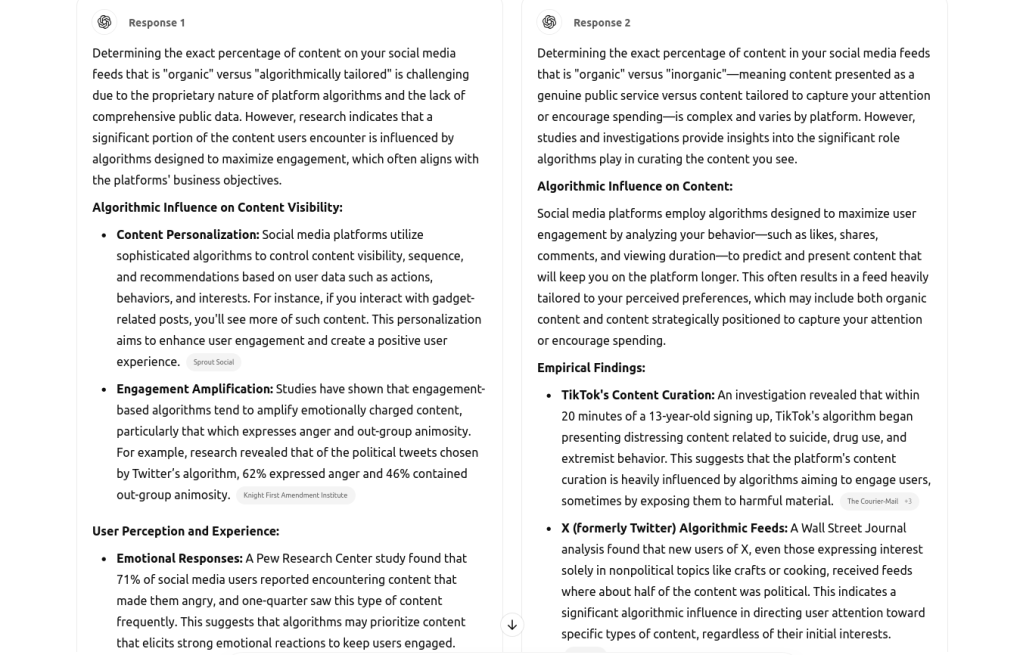
INSANCTUM:
Combine them, im looking for empirical data and theres some from different studies in each.
CHATGPT:
Determining the exact proportion of organic versus algorithmically tailored content in social media feeds is complex and varies across platforms. However, empirical studies provide insights into the significant influence algorithms have on the content presented to users.
Algorithmic Influence on Content Exposure:
- X (formerly Twitter): A Wall Street Journal analysis revealed that new users interested in nonpolitical topics like crafts or cooking still encountered feeds where approximately 50% of the content was political, often favoring specific viewpoints.
- Facebook: Research indicates that the median user receives a majority of their content from politically like-minded sources—50.4% from like-minded sources compared to 14.7% from opposing viewpoints. Moody College of Communication
Impact on User Perception and Behavior:
- Exposure to Violent Content: A study by the Youth Endowment Fund found that 68% of teenagers who encountered weapons online felt less inclined to go out, highlighting how algorithmically promoted violent content can influence real-world behaviors. The Guardian
- Misinformation Amplification: Algorithms tend to amplify content that elicits strong emotional reactions, which can lead to the spread of misinformation and increased polarization. Researchers suggest that social media platforms could mitigate this by adjusting algorithms to promote diverse content and limit the amplification of polarizing material. Neuroscience News
Conclusion:
While precise percentages of organic versus algorithmically tailored content are difficult to ascertain, empirical evidence underscores the substantial role algorithms play in shaping social media feeds. This influence often prioritizes engagement and monetization over the delivery of content intended solely for public service.
SO HOW MUCH OF ‘US’ IS FROM THE SCREEN? HOW MUCH OF THE SCREEN IS CURATED WITH MANIPULATIVE INTENT?
Short answer: I don’t know yet.
How Algorithms Run The World We Live In
First, what do we mean when we use the term problem? In computer science, a problem is a task that when it is solved produces the desired result. This is math-speak for the problem is the barrier between your current position or state and position or state you want to be in. The barrier between you and your destination is the problem. What you need now is a door that turns a problem into a process that ends with you being in the desired position or state.
Seven Essential Algorithms That Run The World
NYT – We Might Never Know How Much the Internet Is Hiding From Us
Recency bias is a cognitive bias that favors recent events over historic ones; a memory bias. Recency bias gives “greater importance to the most recent event”, such as the final lawyer’s closing argument a jury hears before being dismissed to deliberate. Recency bias should not be confused with anchoring or confirmation bias. Wikipedia
An algorithm is a set of rules or steps followed, often by a computer, to produce an outcome.
Origins & Social Meanings of Algorithmic Culture
To talk about and investigate algorithmic culture then means having to enter in “the role of computers, large data sets, and mathematics in establishing, maintaining, and transforming the frameworks by means of which human beings orient our judgments, actions, and dispositions toward one another and toward the surrounding world”
How Algorithms Amplify Our Own Biases And Shape What We See Online
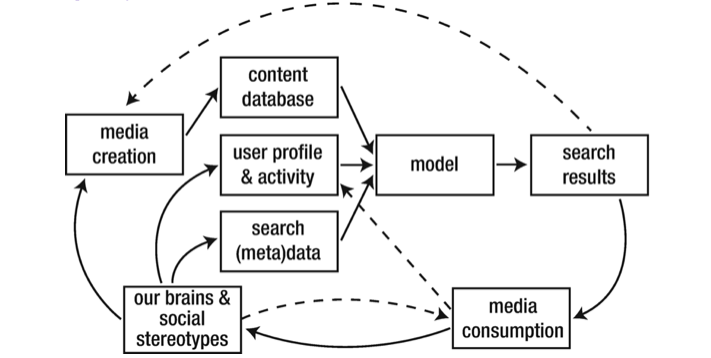
Some existing counter-efforts:
Filter Bubble Transparency Act
The bill would require large-scale internet platforms that collect data from more than 1 million users and gross more than $50 million per year to provide greater transparency to consumers and allow users to view content that has not been curated as a result of a secret algorithm. The Filter Bubble Transparency Act would make it easier for internet platform users to understand the potential manipulation that exists with secret algorithms and require large-scale platforms to allow those users to consume information outside of that potential manipulation zone or “filter bubble.”
-
+
+
+
+
+
+
This is a post. It includes some topics, and some subtopics.
 INSANCTUM